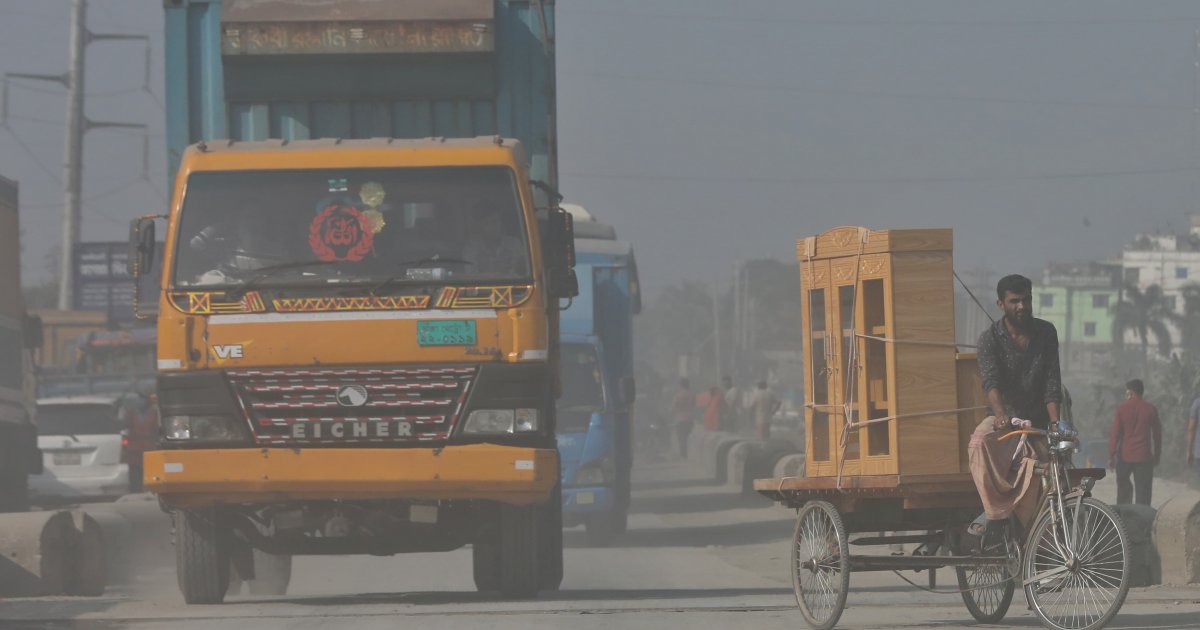
Dhaka's air quality remained moderate on Monday morning, with an Air Quality Index (AQI) of 79.
The capital ranked 18th among the world's most polluted cities at 8:10 am, according to the AQI scale, while its air quality was classified as "moderate." Pakistan’s Lahore, Uganda's Kampala and Indonesia’s Jakarta occupied the first three spots on the list with AQI scores of 195, 179 and 177, respectively.
An AQI between 50 and 100 is considered "moderate" with an acceptable air quality while AQI between 101 and 150 is considered ‘unhealthy for sensitive groups’, while a score between 151 and 200 is classified as ‘unhealthy’.
AQI readings between 201 and 300 are termed ‘very unhealthy’, and anything above 301 is considered ‘hazardous’, posing serious health risks.
The AQI is a daily indicator of air quality, showing how clean or polluted the air is and the possible health effects people may experience.
In Bangladesh, the AQI is calculated based on five major pollutants: particulate matter (PM10 and PM2.5), nitrogen dioxide, carbon monoxide, sulphur dioxide and ozone.
Dhaka has long struggled with severe air pollution.
Air quality usually worsens during winter and improves in the monsoon season.